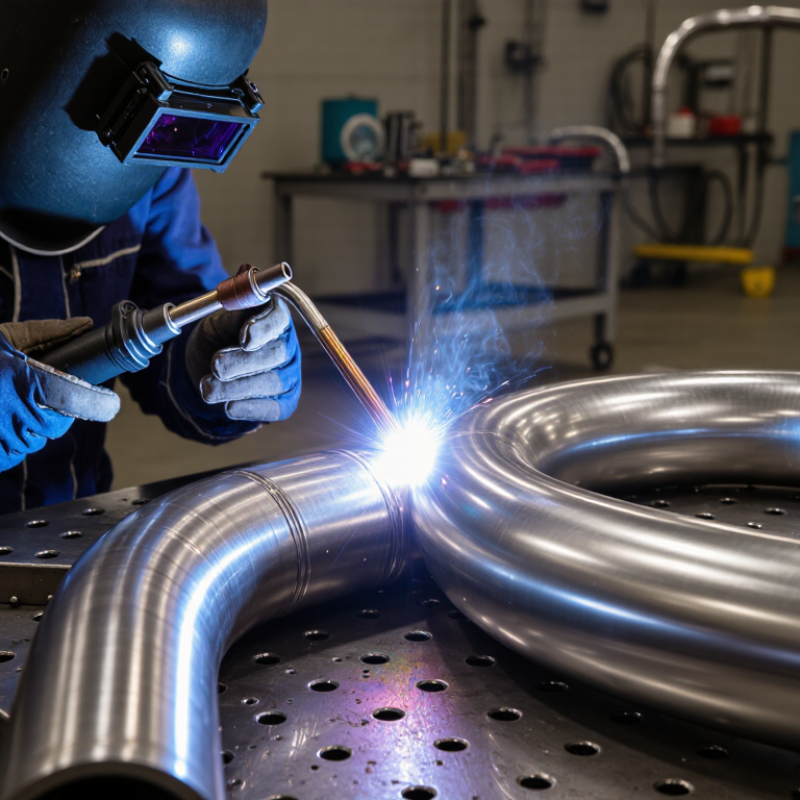
| Gas Tungsten Arc Welding (GTAW / TIG) | Approximately 0.5–6 mm for many manual applications; thicker sections may require multiple passes | High-purity argon shielding for the arc, weld pool, electrode, and heated trailing area | Excellent control, clean welds, low spatter, and strong results on thin titanium components | Aircraft components, chemical-processing pipework, heat exchangers, medical parts, and precision fabrications | Relatively slow; highly sensitive to surface contamination, drafts, and inadequate post-weld shielding | Excellent for thin-to-medium titanium sections and high-quality joints |
| Laser Beam Welding (LBW) | Approximately 0.1–8 mm, depending on laser power, joint design, and material condition | Localized inert-gas shielding, usually argon or helium; some systems use controlled chamber protection | Low heat input, narrow heat-affected zone, low distortion, high speed, and suitability for automation | Automotive and aerospace assemblies, thin tubing, battery-related components, precision instrument parts, and hermetic joints | Higher equipment cost; tight fit-up, accurate joint preparation, and process control are required | Excellent for automated, repeatable, low-distortion production |
| Electron Beam Welding (EBW) | From thin sheet to thick sections; deep-penetration capability can support multi-millimeter and substantially thicker joints | Vacuum chamber, which minimizes atmospheric contamination during welding | Very deep penetration, narrow heat-affected zone, low distortion, and high weld purity | Aerospace structures, high-integrity pressure components, propulsion hardware, and critical titanium assemblies | Requires vacuum equipment; chamber size can limit component dimensions and production flexibility | Excellent when weld integrity and deep penetration outweigh equipment complexity |
| Plasma Arc Welding (PAW) | Approximately 1–10 mm, with keyhole operation used for suitable joint geometries | Inert plasma and shielding gases, commonly argon-based mixtures | More concentrated arc than conventional TIG, good penetration, and potential for mechanized production | Tube and pipe fabrication, aerospace parts, chemical equipment, and medium-thickness sheet assemblies | More complex setup than TIG; torch alignment, gas coverage, and parameter control are important | Very good for mechanized welding of thin and medium sections |
| Gas Metal Arc Welding (GMAW / MIG) | Approximately 3–12 mm in specialized applications, depending on alloy, transfer mode, and shielding design | High-purity inert shielding gas, generally argon or helium-rich mixtures | Higher deposition rate than TIG and better productivity for longer welds | Large structural fabrications, thicker plate, and production work where productivity is important | Greater risk of contamination, spatter, porosity, and weld-quality variation; less common than TIG for critical titanium work | Good with strict control for production applications requiring higher deposition rates |
| Resistance Spot Welding (RSW) | Typically thin sheets, often below approximately 3 mm total stack thickness | Shielding gas is generally not required because the weld is formed between electrodes, although surface cleanliness remains essential | Fast cycle times, repeatability, and suitability for overlapping sheet assemblies | Thin titanium sheet components, brackets, enclosures, and selected aerospace subassemblies | Limited joint geometry; electrode force, current, surface condition, and heat balance must be carefully controlled | Good for repetitive lap joints in thin sheet |
| Friction Stir Welding (FSW) | Commonly used for sheet and plate assemblies; practical thickness depends strongly on tool design and machine capacity | Solid-state process; no melting, filler metal, or conventional arc shielding is required | Low distortion, reduced solidification defects, and no need for filler metal or arc generation | Selected plate structures, transportation components, and research or specialized industrial assemblies | Requires specialized tooling, rigid fixturing, high machine forces, and suitable joint access | Promising to very good for compatible linear joints and solid-state applications |