Why Choose an EV Charger Type 2?
Choosing the right home or workplace charger can feel surprisingly complicated. An Ev Charger Type 2 offers a practical starting point for many electric vehicle owners, especially across Europe and other regions using the IEC 62196-2 connection standard. Its familiar rounded plug supports reliable alternating-current charging and suits many modern vehicles.
Picture arriving home with 30% battery remaining. You connect the cable, check the charging indicator, and let the vehicle charge overnight. Depending on the car, charger output, and electrical supply, charging may take several hours. A Type 2 connection can support different AC power levels, but the vehicle usually controls the actual charging rate. That detail matters.
Real-world experience also reveals limitations. A compatible plug does not guarantee fast charging. Installation quality, cable length, load management, and household capacity can change the result. Some drivers expect dramatic speed improvements, then discover their vehicle accepts less power than the wall unit provides. That can be disappointing.
Still, the format offers important advantages. It is widely recognized, easy to use, and commonly supported by public charging networks. Many units also include safety monitoring, weather-resistant housings, and smart scheduling features. Buyers should verify the vehicle manual, charger specifications, connector design, and local installation requirements before purchasing. A qualified electrician can assess circuit capacity and protective equipment.
No charger fits every situation. The best choice depends on driving distance, parking time, budget, and available power. This guide examines why an Ev Charger Type 2 remains a dependable option, while also questioning where its benefits may be overstated.
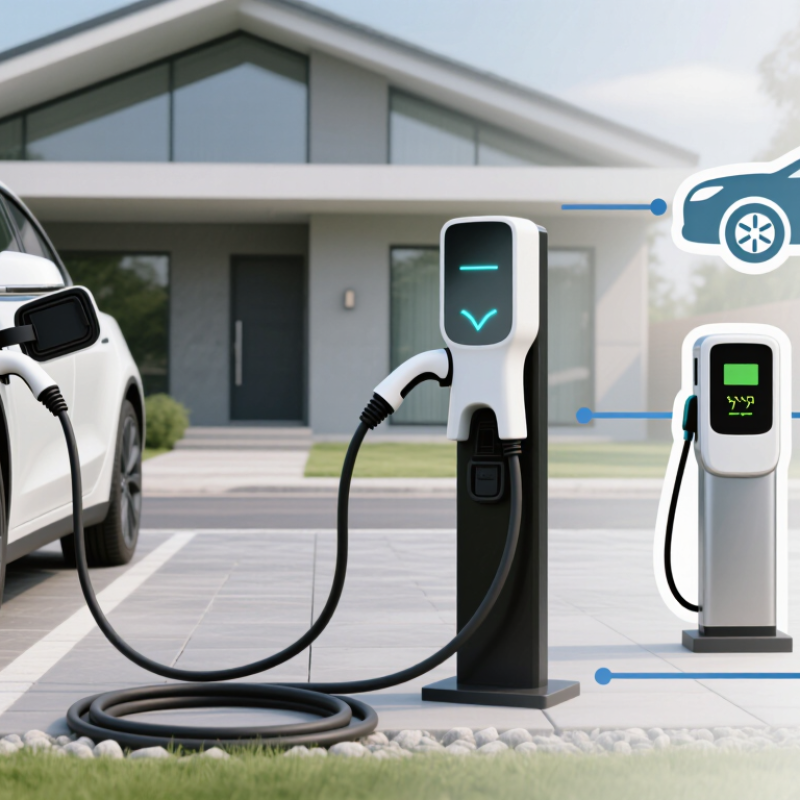
What Is a Type 2 EV Charger Under IEC 62196-2?
A Type 2 EV charger refers to an AC charging connection defined under IEC 62196-2. More precisely, Type 2 describes the plug, socket, vehicle connector, and vehicle inlet. The actual charging equipment is usually called EVSE, while the vehicle’s onboard charger converts AC power into battery energy. This distinction is often missed.
Type 2 uses seven contacts: three phase lines, neutral, protective earth, control pilot, and proximity pilot. It can support single-phase or three-phase AC charging, depending on the vehicle and electrical installation. Some systems deliver up to 43 kW, but that figure is not guaranteed. Cable rating, supply capacity, onboard charger limits, and local installation rules all matter. In practice, a residential setup may provide 3.7 or 7.4 kW, while a suitable commercial connection can offer more.
The control pilot manages communication between the vehicle and charging equipment. It helps confirm connection status and available current before power flows. The proximity pilot can help detect cable presence and release conditions. These details make Type 2 practical for daily charging, workplace use, and public AC stations.
I have seen users compare connectors by shape alone. That is risky. A familiar socket does not prove fast charging capability. Installation quality matters too. Even a compliant Type 2 system can perform poorly when cables are undersized, ventilation is ignored, or load management is absent. Some technical explanations also call the connector itself a charger. That wording is convenient, but not fully accurate.
How Type 2 Delivers 3.7–22 kW of AC Charging Power
Why Choose an EV Charger Type 2?
Type 2 charging supports practical AC power from 3.7 to 22 kW. The exact output depends on voltage, current, phases, and the vehicle’s onboard charger. At home, 3.7 kW usually means 230 volts and 16 amps on a single-phase supply. A 7.4 kW setup may use 32 amps. These levels suit overnight charging and many residential installations.
Three-phase power changes the picture. An 11 kW Type 2 charger commonly uses 16 amps across three phases. A 22 kW unit generally needs 32 amps and a suitable three-phase connection. Charging is noticeably faster, especially for larger batteries or frequent daily driving. However, the vehicle must accept that power. A 22 kW wall unit cannot force a car’s 11 kW onboard charger to charge faster.
The simple wattage story is incomplete. Installation quality matters. Cable size, circuit protection, load balancing, and local electrical standards all affect safe performance. In real installations, technicians often discover that household demand reduces available charging power. A kitchen appliance or heat pump can matter. Small details count. Type 2 also offers a secure connection and broad compatibility across many AC charging systems. Still, selecting the highest rating is not always sensible. A lower-power unit may cost less, place less pressure on the supply, and fully recharge a vehicle overnight. The right choice starts with actual driving distance, battery capacity, and available electrical service.
Why Choose an EV Charger Type 2?
How Type 2 delivers approximately 3.7–22 kW of AC charging power
Type 2 AC charging power depends on the supply phase, voltage, and current. Single-phase charging commonly provides about 3.7 or 7.4 kW, while three-phase charging can provide approximately 11 or 22 kW. Values are calculated from nominal European AC voltages and currents: single-phase power is approximately 230 V × current, and three-phase power is approximately 400 V × current × √3.
Why 400 V, 32 A Type 2 Charging Fits European EVs
Why Choose an EV Charger Type 2?
Why 400 V, 32 A Type 2 Charging Fits European EVs
Type 2 charging matches Europe’s common electrical infrastructure and vehicle standards. Under IEC 62196-2, Type 2 supports safe AC charging with communication between the car and charger. At 400 V, three-phase power and 32 A can provide approximately 22 kW before charging losses. That can add meaningful range during a few hours at home, work, or a public car park.
The fit is practical, not perfect. Many European EVs accept 11 kW AC, while some accept 22 kW. The vehicle’s onboard charger remains the limiting component. A 22 kW charger cannot force an 11 kW car to charge faster. Not always.
The International Energy Agency’s Global EV Outlook 2024 reported more than three million electric cars sold in Europe during 2023. ACEA data also placed the European Union’s public charging stock above 630,000 points by the end of 2023. These figures show why compatible, dependable AC equipment matters in everyday charging networks.
In real use, cable length, phase availability, temperature, and battery state affect results. A cold battery may charge more slowly. A shared building may also restrict current to protect its electrical supply. The 400 V, 32 A specification is therefore a strong European fit, but treating it as a guaranteed 22 kW experience is an easy mistake. Reliability comes from checking the car’s AC limit, installation capacity, and protective controls before choosing the charger.
How IEC 61851 Safety Communication Protects Type 2 Charging
Type 2 charging is more than a familiar plug and socket. Its main strength is controlled communication. Under IEC 61851, the control pilot signal tells the vehicle when a connection is detected, when charging may begin, and how much current is available. A duty cycle then communicates the permitted current from the charging equipment. This prevents a vehicle from drawing more power than the circuit can safely provide.
The protection is visible in small details. During commissioning, installers check the pilot signal, protective earth, and connector locking before energizing the circuit. If communication fails, charging should stop. That pause matters beside a garage wall, where heat, moisture, or a damaged cable may go unnoticed. The International Energy Agency reported almost 14 million electric car sales worldwide in 2023, increasing the need for dependable charging controls. The International Electrotechnical Commission also places communication and protective functions at the center of conductive charging safety.
Still, IEC 61851 is not magic. It does not replace correct wiring, residual-current protection, thermal management, or regular inspection. Some installations need additional direct-current fault protection, depending on the equipment and local requirements. The Global EV Outlook 2024 also noted that public charging infrastructure must expand rapidly with electric vehicle adoption. Type 2 systems help because their safety process is structured, testable, and familiar to qualified technicians. One missed inspection can weaken that confidence. Safety lives in the details.