

China’s asparagus industry operates at a demanding scale, making sorting quality a commercial priority. FAOSTAT production data consistently identifies China as the world’s leading asparagus producer. The International Trade Centre also records significant asparagus movements under HS 070920. These figures reveal a large supply base, but they do not guarantee uniform quality. Field maturity, soil particles, broken tips, and color variation can challenge every packing line.
An Asparagus Optical Sorter uses cameras, controlled lighting, algorithms, and mechanical ejection systems. It can inspect spears quickly while reducing repetitive manual checking. In practical processing environments, the best machine is not always the fastest one. Stable feeding matters. So does gentle handling. A sorter that damages tips may create greater losses than it prevents. USDA produce-quality guidance also emphasizes appearance, defects, and safe handling, which should influence equipment testing.
This guide examines China’s leading asparagus optical sorter manufacturers through measurable criteria. These include detection accuracy, throughput, cleaning design, software support, spare-part access, and trial performance. Manufacturer claims require caution. A glossy brochure can hide inconsistent results under real moisture and dust conditions. Buyers should request samples, rejection photographs, and written test records. No ranking is perfect. Regional service and operator training may matter more than a small speed advantage. The strongest suppliers usually explain limitations clearly, provide factory demonstrations, and adapt the sorting recipe to white or green asparagus. That practical honesty deserves attention when comparing China’s top manufacturers.
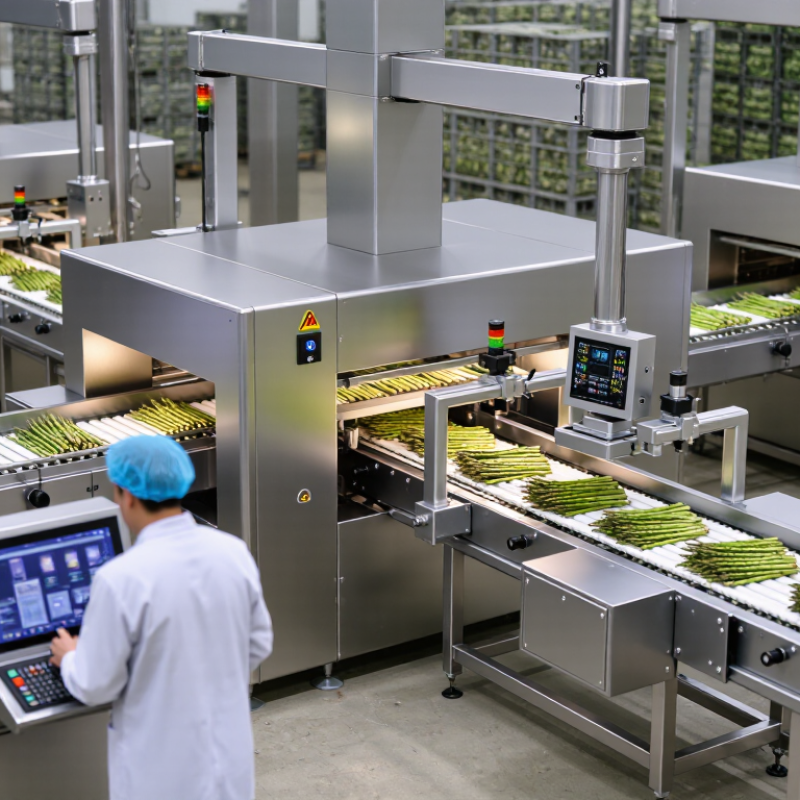
Asparagus optical sorters help processors remove discolored spears, damaged tips, foreign material, and inconsistent sizes. Chinese manufacturers commonly design these machines for fresh, washed, or trimmed asparagus lines. Their purpose is simple: improve grading accuracy while reducing manual inspection pressure. A conveyor moves each spear beneath controlled lighting. Cameras capture color, shape, length, and surface defects. Software then compares each image with preset quality standards. Small air jets separate rejected pieces within milliseconds.
Tips: Test samples from different harvest periods. Green and purple asparagus can reflect light differently. Keep lenses clean, and recalibrate after changing belt speed. Do not trust factory settings blindly.
Core performance depends on more than camera resolution. LED lighting must reveal bruises without creating glare. RGB cameras identify color variation, while near-infrared sensors may detect hidden moisture or material differences. Algorithms assess tip shape, curvature, diameter, and blemish location. Precise timing is also essential; a weak air valve can miss a damaged spear. During evaluation, measure false rejects and missed defects separately. A sorter that rejects too much product may look accurate, but it can reduce yield. This is where practical testing matters. Machine data should support human quality judgment, not replace it completely.

Evaluating Chinese asparagus optical sorter manufacturers requires more than comparing prices or polished factory videos. In practical trials, begin with a representative sample: thin spears, curved pieces, broken tips, and soil-stained surfaces. Ask the manufacturer to record sorting accuracy, throughput, and waste rates under identical conditions. A clear test report matters more than a general promise.
Inspect the machine’s imaging system closely. High-resolution cameras, stable lighting, and adjustable air-jet timing affect results. The software should distinguish color, diameter, bruising, open tips, and foreign material. Request data from several harvest batches, not one perfect sample. That reveals consistency. It also exposes weaknesses.
Review the manufacturer’s engineering experience and quality controls. Check component origins, electrical safety documents, calibration procedures, and factory acceptance records. A reliable supplier should explain maintenance intervals and provide practical training. Ask how quickly technicians respond when a nozzle blocks or camera readings drift. Small delays can damage fresh produce. Spare parts availability is important.
Visit an operating installation when possible. Watch workers clean lenses, remove rejected asparagus, and adjust settings during changing moisture levels. A useful supplier will discuss limitations honestly, including false rejects and performance loss with irregular produce. This candor is valuable. Contracts should define acceptance standards, warranty coverage, installation duties, and performance testing. One overlooked detail can become an expensive disagreement.
Chinese asparagus optical sorter manufacturers increasingly serve fresh-produce processors with configurable inspection systems. Their equipment commonly combines color cameras, near-infrared sensors, air nozzles, and adjustable conveyor channels. These tools can identify brown tips, bruises, foreign material, uneven color, and damaged stalks. Some manufacturers also offer grading by diameter, length, and visual quality.
Product capability varies considerably between factories. Experienced suppliers usually provide sample testing before production, using real asparagus from the buyer’s fields or packing line. This matters because surface moisture, soil residue, and tightly packed tips can reduce recognition accuracy. A practical trial should measure sorting accuracy, product loss, processing speed, and cleaning time. Touchscreen controls, recipe storage, remote diagnostics, and multilingual interfaces can simplify daily operation. Stainless-steel frames and sealed electrical cabinets are useful in wet processing areas.
Customization is another strength among Chinese manufacturers. They may adjust belt width, channel number, lighting position, ejector timing, and discharge layout for different facilities. However, no sorter removes every defect. Pale scars can resemble natural color changes, while soft stalks may deform during feeding. This is where technical honesty matters. Buyers should request recorded test results, maintenance schedules, operator training, and clear warranty terms. A supplier’s response to failed samples often reveals more than a polished machine demonstration.
Commercial asparagus optical sorters commonly combine color, size, shape, surface-defect, and foreign-material inspection. The diameter classes below are based on widely used asparagus sizing thresholds, converted from inches to millimeters, and are relevant to automated grading and sorting configuration.
China Top Asparagus Optical Sorter Manufacturers?
Comparing asparagus optical sorters requires more than watching a polished factory demonstration. Request a test using your own samples, including thin spears, bent pieces, broken tips, and soil marks. Measure both removal accuracy and false rejection. A machine that removes defects well but discards premium asparagus can quietly reduce profits. Ask for recorded results, sample size, lighting conditions, and belt speed. Without these details, accuracy claims remain difficult to trust.
Capacity must match your real harvest flow, not an impressive maximum figure. Check kilograms per hour at the required sorting accuracy. Observe product movement closely. Crowded belts may cause missed defects or bruising. Also examine recipe changes, cleaning access, sensor calibration, and operator training. I have found that small interface delays can become expensive during peak harvest. That detail is easy to overlook.
Tips: Compare at least three test reports. Ask how accuracy changes after eight hours of operation. Confirm warranty coverage, spare-part availability, response times, and remote support hours. A reliable supplier should explain maintenance intervals and provide practical training. Ask for customer references with similar asparagus sizes and seasonal volumes. Do not judge service by friendly sales calls alone. Speak with the technical team. Even strong equipment can disappoint when calibration support is slow. Allow room for doubt, and verify every important promise in writing.
China Top Asparagus Optical Sorter Manufacturers
Asparagus optical sorters are used for grading fresh spears by color, diameter, length, and visible defects. In packing facilities, cameras inspect products while conveyors maintain a steady flow. The system can remove bruised tips, excessive discoloration, and unwanted foreign material. However, uneven bundles or wet surfaces may reduce accuracy. Operators should test real harvest samples, not only clean demonstration products.
Maintenance directly affects sorting quality. Clean camera lenses, LED lights, and protective windows during each production shift. Dust and asparagus residue can create false rejection signals. Check air nozzles, conveyor belts, and sensors every day. Calibration should follow changes in variety, lighting, and product temperature. Keep a simple record of rejected samples and machine adjustments. Small records reveal recurring problems. One practical weakness is human overconfidence; operators may trust automatic settings without checking the actual product.
When comparing Chinese asparagus sorter manufacturers, buyers should examine throughput, detection resolution, adjustable channels, and product handling. Ask whether the machine supports different spear sizes without excessive bruising. Confirm the availability of spare parts, remote assistance, training, and clear maintenance instructions. Request a sample test using your own asparagus, including thin, curved, wet, and damaged pieces. Review power requirements, cleaning access, food-contact materials, and factory space before ordering. A lower purchase price can become expensive if calibration support or replacement parts are slow.
| Category | Key Dimension | Typical Reference Data | Practical Importance |
|---|---|---|---|
| Applications | Incoming raw asparagus inspection | Detection of foreign material, soil, stones, leaves, damaged pieces, and severe discoloration | Reduces manual inspection workload before grading and packing |
| Color sorting | Separates green, pale, purple, yellowed, and visibly brown asparagus according to configured color thresholds | Supports consistent product grades and improves pack appearance | |
| Defect and quality sorting | Typical defects include broken tips, open tips, mold, bruising, excessive curvature, thin sections, and mechanical damage | Helps protect premium grades from contamination by lower-quality pieces | |
| Size and diameter grading | Common commercial groups may include thin, medium, and thick stalks; exact limits should follow the buyer’s specification | Improves pack uniformity and simplifies pricing by grade | |
| Final packing-line verification | Checks visible defects and grade consistency after trimming, washing, or bundling | Provides an additional quality-control checkpoint before shipment | |
| Sorter Configuration | Inspection technology | Visible-spectrum cameras are commonly used for color and surface defects; near-infrared or multispectral sensing may assist with selected foreign-material or quality applications | The sensor package should match the defect types, product color, and moisture condition |
| Feeding method | Belt, chute, or roller feeding; controlled spacing and stable product orientation improve image quality | Poor alignment or overlapping stalks can reduce recognition accuracy | |
| Nominal throughput | Often specified by the equipment supplier in kilograms per hour or pieces per minute; actual capacity depends on stalk size, spacing, defect rate, and sorting criteria | Request a throughput test using the buyer’s own asparagus samples rather than relying only on catalog figures | |
| Ejection mechanism | Air-jet ejection is widely used for lightweight food products; mechanical gates may be used in certain grading layouts | Ejection timing and air pressure affect good-product loss and defect removal efficiency | |
| Product condition | Fresh, clean, and consistently oriented asparagus generally provides more stable results than wet, muddy, or heavily overlapping product | Pre-cleaning, dewatering, and singulation may be needed before optical inspection | |
| Control system | Recipe-based settings, touchscreen operation, defect libraries, sensitivity adjustment, and production statistics are common requirements | Simple recipe changeover helps operators manage different varieties, seasons, and customer specifications | |
| Maintenance | Daily cleaning | Remove asparagus residue, dust, soil, and water from belts, chutes, guards, reject channels, and accessible optical windows after each production shift | Residue and water droplets can obstruct sensors and cause unstable classification |
| Camera and lighting inspection | Check lens covers, protective glass, LED illumination, image uniformity, and focus according to the maintenance manual | Clean and stable imaging is essential for detecting subtle color and surface differences | |
| Air system service | Inspect compressor output, filters, regulators, tubing, valves, and nozzle blockage; use dry, filtered compressed air | Unstable pressure or blocked nozzles can cause missed rejects or excessive good-product ejection | |
| Conveyor and mechanical parts | Check belt tracking, tension, rollers, bearings, fasteners, guards, and product-contact surfaces at scheduled intervals | Mechanical vibration and irregular feeding can reduce sorting consistency | |
| Calibration and recipe verification | Verify calibration after cleaning, component replacement, software updates, or major changes in product condition | Prevents gradual drift in color thresholds, defect recognition, and ejection timing | |
| Hygiene and safety | Use food-processing-compatible materials and cleaning procedures; isolate power and compressed air before servicing | Supports food safety, operator safety, and compliance with the facility’s sanitation program | |
| Buying Considerations | Sample testing | Provide representative samples covering different varieties, sizes, colors, moisture levels, and defect types | A sample test is the most reliable way to assess detection, throughput, and good-product retention |
| Performance indicators | Evaluate defect removal rate, false-reject rate, good-product recovery, repeatability, and actual throughput | A high nominal capacity is not sufficient if product loss or missed defects is excessive | |
| Line integration | Confirm compatibility with washers, dewatering units, graders, conveyors, weighing systems, packing machines, and reject collection | Correct infeed and discharge design prevents bottlenecks and product damage | |
| Cleaning and environmental rating | Check enclosure protection, washdown limitations, corrosion resistance, drainage, and approved cleaning chemicals | The correct protection level depends on whether the sorter is installed in a dry, damp, or washdown area | |
| Utilities | Confirm electrical supply, compressed-air quality and consumption, operating temperature, floor space, and required clearance | Utility mismatches can prevent stable operation and increase installation costs | |
| Service and spare parts | Ask about response time, remote support, technician availability, recommended spare parts, software support, and training | After-sales capability directly affects seasonal uptime and maintenance cost | |
| Total cost of ownership | Consider purchase price, installation, integration, compressed-air use, labor savings, maintenance, spare parts, downtime, and expected service life | The lowest initial price may not provide the lowest long-term cost per sorted kilogram |
Note: Performance figures and specifications vary by machine design, asparagus variety, product condition, sorting criteria, and line configuration. Confirm final capacity, accuracy, utility requirements, and sanitation limits through a sample test and the supplier’s technical documentation.
