



10 Tips for Buying Heavy Construction Equipment?
Buying heavy construction equipment is a major capital decision, not a simple dealership visit. A crawler excavator may look powerful on a clean yard, yet its real value appears on a muddy, demanding worksite. Buyers must compare productivity, fuel use, maintenance access, operator comfort, resale value, and dealer support. One impressive specification cannot answer every operational question.
Industry reports reinforce this caution. The Association of Equipment Manufacturers regularly highlights changing construction demand, equipment sales trends, and technology adoption in North America. Off-Highway Research’s market outlooks also show how infrastructure investment, rental activity, and regional economic conditions influence equipment demand. Deloitte’s 2024 Engineering and Construction Industry Outlook identifies cost pressure, labor shortages, digital tools, and project uncertainty as continuing industry concerns. These findings make careful purchasing more important than ever.
The following ten tips focus on decisions buyers often underestimate. They address total cost of ownership, machine utilization, inspection records, financing, attachments, safety features, emissions expectations, and after-sales service. A machine that saves fuel may still disappoint if parts arrive slowly. A cheaper used loader may become expensive after repeated hydraulic repairs. No checklist is perfect. Real sites are unpredictable. Even experienced contractors can misjudge annual utilization or future project requirements. That is why reliable data, independent inspections, operator feedback, and documented dealer commitments should support every purchase. Use these tips as a practical framework, then challenge each assumption against your budget, terrain, workload, and maintenance capability.
Define the Project Requirements and Equipment Specifications
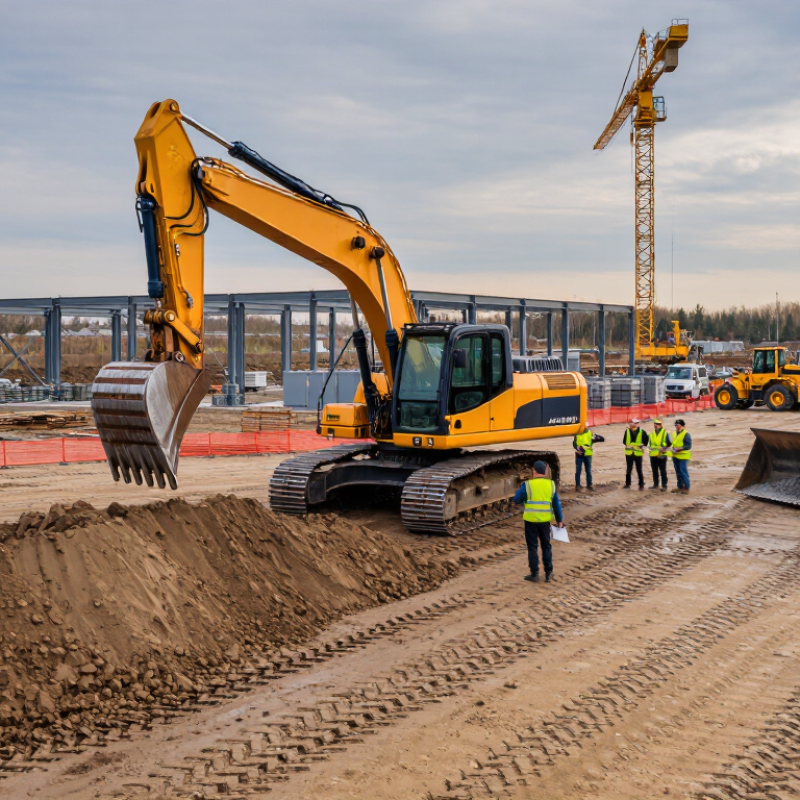
Before requesting equipment quotes, walk the actual jobsite and record its working conditions. Measure access roads, turning areas, ground firmness, overhead clearance, and nearby structures. Define the project’s daily output, operating hours, material type, and expected completion date. A machine chosen only by purchase price can become expensive when it moves slowly or needs constant support. Write these requirements down. Vague expectations create unreliable comparisons.
Match each requirement with measurable equipment specifications. For excavation, calculate bucket capacity, digging depth, reach, breakout force, and cycle time. For lifting, confirm rated capacity at the required radius, not only the maximum rating. Check operating weight, transport dimensions, fuel or energy use, attachment compatibility, and noise limits. The worksite may also require low ground pressure or extra stability. Small details matter.
Ask suppliers for test records, maintenance schedules, inspection reports, and realistic productivity estimates. Request references from projects with similar soil, loads, and operating conditions. Review operator visibility, control layout, emergency features, and access for daily servicing. A ten-minute inspection can reveal loose pins, damaged hoses, or poor access panels. I have seen specifications look perfect on paper, yet fail against muddy ground and tight entrances. Recheck your assumptions before signing. That step is easy to skip.
| Tip | Project Requirement | Recommended Equipment Class | Key Specification to Define | Typical Planning Range | Why It Matters |
|---|---|---|---|---|---|
| 1 | Define the primary task and expected production output. | Hydraulic Excavator | Operating weight, bucket capacity, digging depth, and cycle time. | 10–30 metric tons; bucket capacity of approximately 0.4–1.5 m³. | Matching machine size to the excavation volume helps avoid low productivity, excessive fuel use, and unnecessary capital cost. |
| 2 | Measure the material volume, haul distance, and site access conditions. | Articulated Dump Truck | Payload, body volume, turning radius, and gradeability. | Payload of approximately 25–45 metric tons for large earthmoving projects. | Payload must be compatible with the loading equipment so trucks are filled efficiently without overloading. |
| 3 | Identify required lift height, reach, and load weight. | Rough-Terrain Telehandler | Maximum lift capacity, maximum lift height, forward reach, and attachment rating. | Lift heights commonly range from about 6–18 m; capacity decreases as forward reach increases. | Load charts are essential because rated capacity varies according to boom angle, reach, stabilizer position, and attachment type. |
| 4 | Determine the required compaction level and soil or aggregate type. | Vibratory Soil Compactor | Drum width, operating weight, vibration frequency, and centrifugal force. | Drum widths of approximately 1.5–2.2 m; operating weights of about 8–20 metric tons. | Amplitude and vibration settings should suit the material to achieve target density without excessive surface disturbance. |
| 5 | Check whether the machine can operate safely on slopes, soft ground, or restricted surfaces. | Crawler Dozer | Operating weight, blade capacity, ground pressure, and maximum blade angle. | Ground pressure commonly falls within approximately 40–90 kPa, depending on undercarriage configuration. | Lower ground pressure can improve flotation on weak soils, while blade configuration affects grading and pushing performance. |
| 6 | Define the required road width, finish tolerance, and paving production rate. | Asphalt Paver | Paving width, hopper capacity, screed heating, and automatic grade control. | Paving widths commonly range from approximately 2.5–7.5 m, depending on the configuration. | The selected width should minimize unplanned joints while remaining suitable for the project’s lane layout and access limitations. |
| 7 | Calculate the required concrete placement rate and delivery schedule. | Truck-Mounted Concrete Pump | Theoretical output, horizontal reach, vertical reach, and pipeline diameter. | Typical outputs range from approximately 60–180 m³/h; vertical reach may exceed 30 m on larger configurations. | Pump capacity must be coordinated with concrete supply so the mix remains workable and placement interruptions are minimized. |
| 8 | Compare the available power supply, duty cycle, and operating environment. | Diesel or Electric Generator | Prime power, standby power, voltage, frequency, fuel autonomy, and emissions requirements. | Prime power should be sized for continuous demand, with reserve capacity commonly planned at approximately 10–20%. | Correct sizing prevents overloads, unstable voltage, excessive fuel consumption, and premature component wear. |
| 9 | Evaluate transportation, assembly, and storage limitations before purchase. | Mobile Crane | Rated capacity, load chart, boom length, axle load, transport width, and setup footprint. | Capacity may range from approximately 25–100 metric tons for common general construction applications. | The crane must be selected using the actual lift radius and site conditions, not only the maximum advertised capacity. |
| 10 | Estimate total ownership cost over the planned service period. | Applicable to All Equipment | Purchase price, fuel or energy use, maintenance intervals, tire or track life, utilization, and resale value. | Use a multi-year cost model based on projected operating hours, scheduled maintenance, repairs, financing, and downtime. | Total cost of ownership gives a more reliable comparison than purchase price alone and highlights the effect of utilization and downtime. |
| Planning values are indicative ranges for preliminary equipment selection. Confirm final specifications with the applicable load charts, site survey, local regulations, and manufacturer documentation before purchase. | |||||
Related Posts
-
Top 10 Best Construction Machines for Every Project?
-

Why Choose the Right Construction Machines for Your Projects?
-
Best Equipment Trader Platforms for Global Buyers?
-
How to Find a Top Heavy Equipment Broker in China?
-
China Top 10 Heavy Equipment Traders for Global Buyers?
-
China Top 10 Heavy Equipment Brokers for Global Buyers